From one honours project to a national academic impact case study
In 2017, Nelson Mandela University honours student Byron Batteson asked a practical question: could children learn the basics of coding without sitting in front of a computer?
In 2017, Nelson Mandela University honours student Byron Batteson asked a practical question: could children learn the basics of coding without sitting in front of a computer?
His project explored what is known as unplugged coding. Learners used physical coding pieces to build a sequence of instructions, then used a mobile phone and image recognition to test whether their code solved a challenge on screen.
That project became the starting point for Tangible. Today, Tangible helps teachers introduce coding and computational thinking through hands-on games and activities. Depending on the age of the learners, that might mean recognising patterns and putting instructions in the right order, or building, testing and correcting more complex sequences of code. The approach gives learners a practical way into the thinking behind coding, even where access to computers, connectivity or electricity is limited.
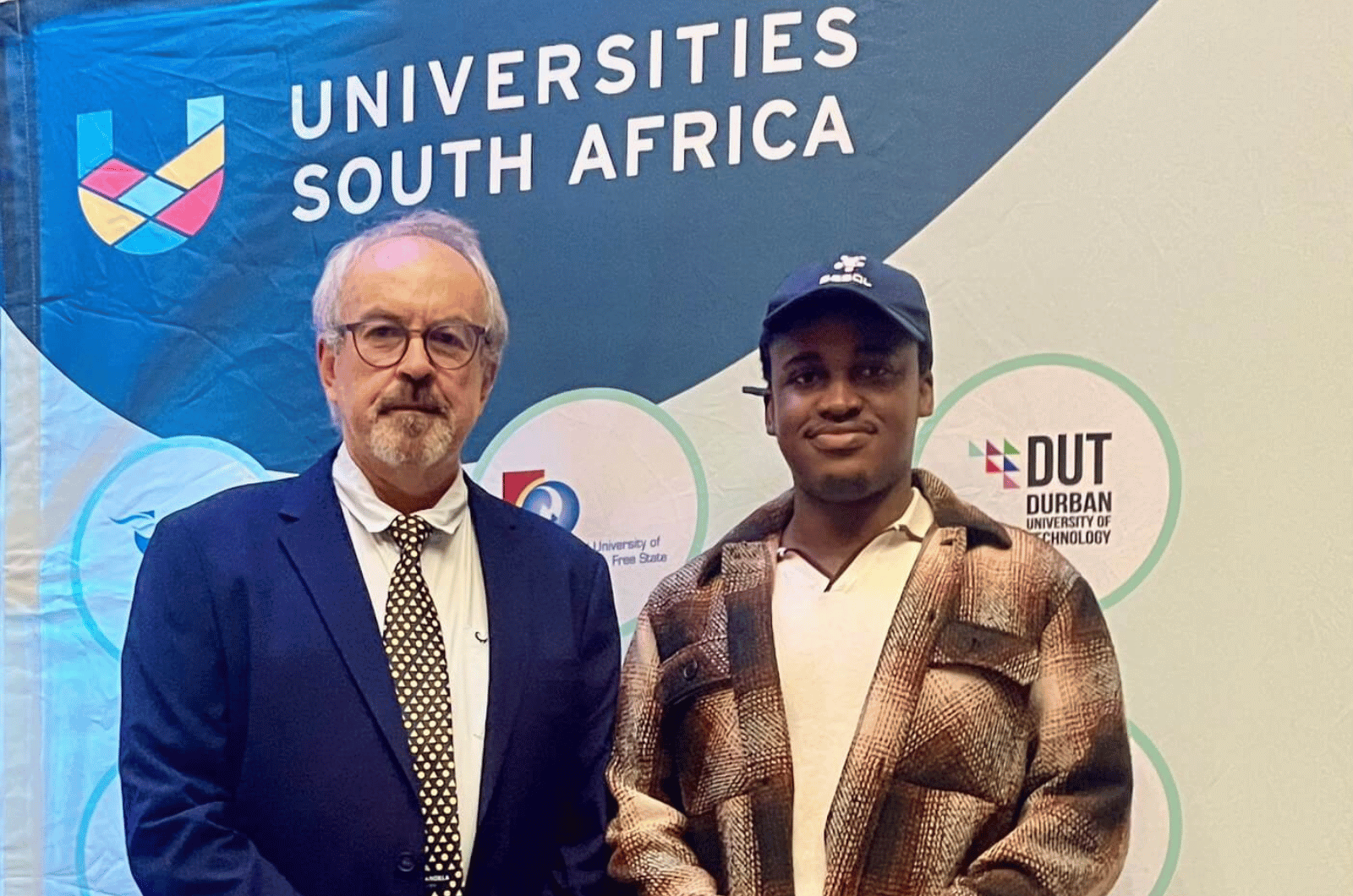
On Friday, Professor Jean Greyling, Head of Computing Sciences at Nelson Mandela University and founder of Tangible, presented the project at the annual Universities South Africa Higher Education Conference in Pretoria. Tangible was one of three national academic impact case studies presented at the conference, after being selected as one of USAf’s top 2025 academic impact case studies.
The work has continued to grow since that first honours project.
Tangible has built a number of game apps to teach computational thinking using the same underlying approach that has been developed, along with teaching and training materials that help teachers use the activities with their own learners. The research around the work has resulted in five journal papers and 12 conference papers, as well as eight PhD studies, with one completed, and seven Master’s studies, with two completed.
Researchers are also applying for ethics approval for an international IFIP study, led by a UK academic, looking at Tangible’s impact on South Africa’s coding landscape.
While the research has continued at the university, Tangible has also moved into schools and communities.
The Gqeberha-based LEVA Foundation now leads its global implementation, working with teachers and partners to take Tangible into schools and communities. More than 300,000 learners across five continents have been reached through its coding activities and apps.
One of those learners is Katlego Nyambi from Soshanguve, who joined Prof Greyling during the USAf presentation. Katlego first encountered Tangible in Grade 11, when his school selected him to attend a Tangible coding workshop in Diepsloot, sponsored by AWS in Communities.
“At the end of Grade 11 I had no idea what I was going to do after school. I thought I did not have many options,” Katlego said at the time.
After the workshop, he joined Tangible Africa’s online C# coding club and completed all the activities.
While he was still at school, he said: “Now I know I want to study computer science at a university and I want to become a software engineer. I am now working towards that dream.”
Katlego is now doing exactly that. He is studying towards a BSc in Computer Science at the University of Pretoria, supported by an Amazon bursary. His story gives a human example of what sits behind the bigger Tangible numbers. An opportunity to try coding helped Katlego see a career path he had not previously considered.
That journey from research to real use is a big part of Tangible’s story.
Tangible did not begin as an education programme that academics later came in to study. It started with one student testing an idea. That led to more apps, more research, more teaching tools and, over time, more opportunities for learners to experience coding in ways that work in very different settings.
The question behind that first honours project still matters: how do we give more children a way into coding and computational thinking, even when they do not yet have access to all the technology usually associated with learning to code?